
Ultrafiltration
| Our Technology |
| UltraPure's membrane
and filtration technologies
are key to providing
water treatment solutions
to meet the
challenges facing our world today. Our expertise encompasses a full range of water treatment processes from Micro and Ultra filtration systems to Reverse Osmosis. 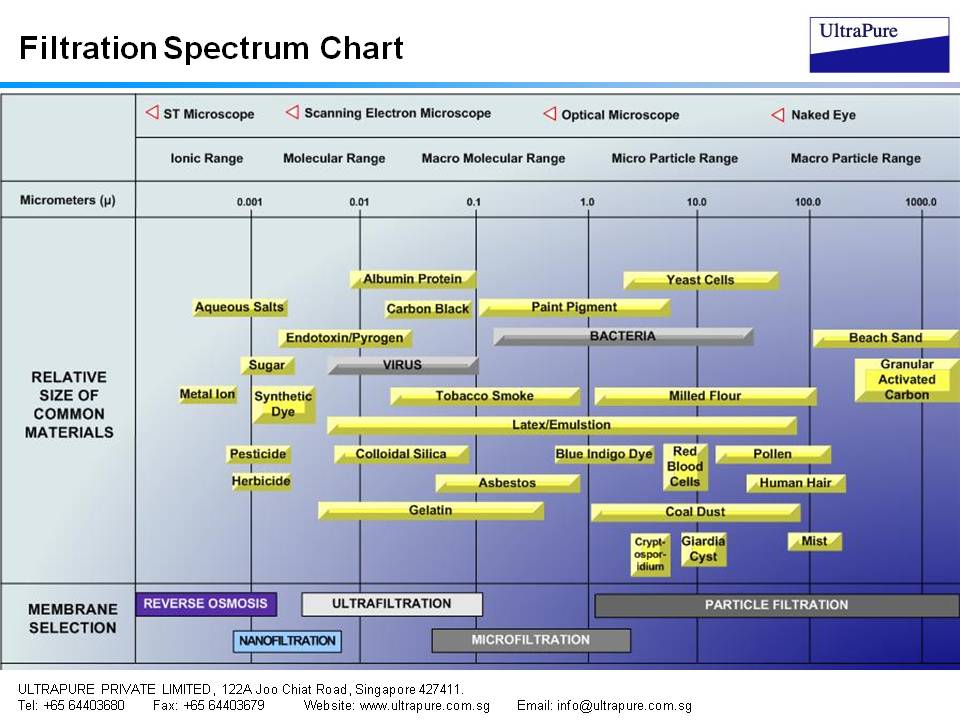 |
| Reverse Osmosis (RO) Technology |
| Reverse
Osmosis (RO) is recognized by
experts
as the best technology available to remove the widest
spectrum of contaminants found in drinking water
(e.g. bacteria, virus,
flouride,
arsenic, suspended solids, dissolved heavy metals and chemicals,
nitrate, microbial
contaminants, salts and other impurities). ref US EPA, Radionuclides in Drinking Water. ref Forbes, How to remove radioactive iodine 131 from drinking water ref Harvard, Impact of flouride on neurological development in children RO is the process by which water molecules are forced through a 0.0001 micron semi-permeable membrane by water pressure. Long sheets of membrane are sandwiched together and rolled up around a hollow central tube in spiral fashion, commonly referred to as spiral wound membrane. RO membranes are available in different sizes for processing different quantities of water. The RO membrane is housed in a housing so that pressure can be maintained on its surface. This pressure forces the water through the membrane, separating it from the unwanted substances like dissolved chemicals, heavy metals, suspended solids, arsenic, salts and other impurities. These unwanted substances are diverted to a reject waste drain so that they do not build up in the system, thus keeping the RO membrane clean and prolonging the membrane life. The UltraPure range of industrial and commercial RO systems uses Ultra Low Pressure Reverse Osmosis membranes. These membranes can be operated at significantly lower operating water pressure compared to conventional reverse osmosis membranes, yet achieving good removal of unwanted substances and a high output flow rate. Often, an RO system comes with pre-filtration tailored to the application, including melt-blown, sediment, carbon and string-wound pre-filters. This is to provide sufficient protection for the RO membrane and prolong its life. Some systems also include post treatment like granular activated carbon (GAC). The quality of RO water is easily measured using a TDS meter or test pen. It is measured in PPM (parts per million) of total dissolved solids (TDS) in the water. |
| Ultrafiltration (UF) Technology |
| Ultrafiltration
is used in water filtration systems to remove bacteria, algae, cysts,
parasites and microbial contaminants. The UltraPure range of water filters uses hollow fibre ultrafiltration (UF) membrane technology. The hollow fibre UF membranes are made from polymeric material and resemble straight lengths of noodles which are hollow on the inside.  On
the surface are very tiny holes or pores which run over the entire
length of the noodles. These pores, which are not visible to the naked
eye, can only be seen using high powered special microscopes. The
tightly controlled microscopic pores range from 0.01 to 0.1 micron in
size. For comparison, the full-stop at the end of this sentence is 500
microns. On
the surface are very tiny holes or pores which run over the entire
length of the noodles. These pores, which are not visible to the naked
eye, can only be seen using high powered special microscopes. The
tightly controlled microscopic pores range from 0.01 to 0.1 micron in
size. For comparison, the full-stop at the end of this sentence is 500
microns.The pores have the ability to stop the passage of particles, turbidity and pathogens such as bacteria, algae, cysts and parasites but allow water and natural, healthy essential minerals such as calcium, magnesium and potassium to flow through. The result is a consistent supply of high quality treated water. The UltraPure range of water filters use UF membrane with outside-in or inside-out configurations depending on specific applications. They require no electricity. Using only the existing water pressure from your water supply, water passes through the water filter and provides safe, clean filtered water on demand. Traditionally, UF membranes were only used in high end and critical applications like municipal water treatment plants, hospitals and pharmaceutical industries. But due to advances in technology, the cost has dropped tremendously and UF membranes are now available for industrial, commercial and residential use. |
